Before the atomic bomb, there was the lion.
To be sure, the dog, the cat, the cow, and the horse had already been lifted out of primeval chaos — not to mention the housefly, cockroach, spider, rat, beetle, butterfly, and gecko.
But it was the lion that left such a singular impression upon me when I was first initiated into the world of animals, who accompany us in our earthly adventure.
For it so happened that, when I was a small boy, a circus troupe came to town, complete with animals, clowns, trapeze artists, traveling players, and, above all, a lion.
Huge posters nailed up on street corners advertised the arrival of the lion in all its power and glory. A thrillingly dangerous, truly terrifying beast! No one should dare approach the cage; for fear the great beast would become enraged, break through the bars, and tear all and sundry to pieces. This was no cute cub or cartoon lion, but an enormous monster, endowed with fabulous strength.
The lion’s name was Marruzko. Those two Rs, with that rancorous Z, a razor-edged K, and the roar of a U in the middle, combined to form a sound to strike fear of God into me.
On opening day, the whole clan set out for the Oriental Circus, which introduced me, for the first time, to the supernatural side of life. A motley crew: people plastered in white greasepaint, huge buttons like sunbursts in a field of silk, tight-rope walkers waving hand-fans over the abyss, others sliding, without falling, onto a giant ball, dancing-girls in Catholic swimsuits, discreet but still revealing enough; a parade of ‘Arabian’ horses ridden by Amazons in very tight-fitting corsets, dishing out kisses; a marching band with its fanfare of bass drums and bugles flaring up at moments when silence would have been more appropriate; and, as the grand finale, Marruzko himself, heralded by a brash burst of brass.
The lion haughtily faced the audience; the tamer in a blue tailcoat and top hat cracked the whip; a disheveled clown simultaneously released large green, red and yellow balloons into the air. The lion stood still and refused to roar. He just let out a disdainful snort, padded around the ring, and returned to his cage without more ado.
As for me, I held my breath. The fact that the lion did not roar, did not appear threatening, earned him my utmost respect. I realized that the lion was no mere heartless brute, but seemed to possess some notion of clemency, perhaps even some reserves of tenderness picked up at his mother’s breast; or, who knows, there may even have echoed in his ears strains of the Orphic song of the thrush or the cooing of turtle doves, of which there were so many flitting about the city.
Days later, with the circus still in town, puzzling rumors began to spread: the lawyer Amanajós… the most Bohemian character in the city, whose life revolved around alcohol, had, at two in the morning, made his way toward the circus and entered the big cat’s cage, which happened to be open. The animal had been sleeping; but that hour had already passed—the tranquil hour when, according to Victor Hugo, the lions go to drink and nothing stirred in Ur or in Jérimadeth.
At eight in the morning, the circus staff were greeted by a rare spectacle: the lion wide awake in its cage, with that chirpy fellow Amanajós sleeping like an angel alongside him. Marruzko, the terrifying lion, was in fact very old, toothless, forgetful—and a vegetarian.
The first and last lion of my life presented me with a conundrum of great import, and one that I would only much later examine in more detail: namely that of whether even the most inhumane of creatures might not be touched in some way, however tenuous, by a certain tenderness—not only the lion and the tiger, but also the executioner, the dictator, the concentration camp commandant, the maker of the Bomb.
Mário de Sá-Carneiro once sent Fernando Pessoa a copy of his poem Dispersal, which ends as follows:
Castles dismantled, winged lions shorn of their manes…
Commenting on these two verses, the author noted:
Lions that are more than lions, because they have wings and yet from whom the mane—the very symbol of the great nobility of these magnificent, golden beasts—has been shorn away.
The same had probably happened to poor Marruzko, who had unwittingly snubbed us. Another Portuguese poet, Teixeira de Pascoaes, in turn, celebrates
lions full of shadow and melancholy,
a verse that is undeniably evocative, but which I cannot consider perfect, owing to the infelicitous use of the adjective “full”—an impropriety on which count many other illustrious authors cannot be said to be free of guilt, some even going so far as to describe people as being ‘full of hunger’.
But it is from Jean Arp, a sculptor, painter and poet whom I greatly revere, that I borrow the leonine conclusion to this page:
Par conséquent le lion est un diamant. The lion is consequently a diamond.
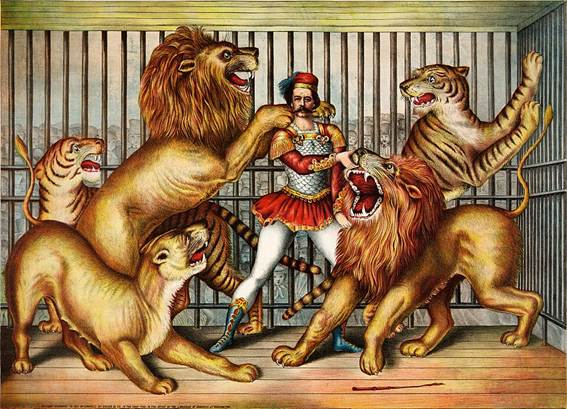
By Gibson & Co. in Library of Congress Prints and Photographs Division Washington, D.C. pga 03749 http://hdl.loc.gov/loc.pnp/pga.03749
 Poetry, Politics and Language