[Bar the odd josh, this a fairly straight translation of Pindar’s First Nemean Ode]
Famed Syracuse islet offshoot, rest-stop revered
where Alpheus stopped off to catch his breath, birth-bed
of Artemis & Apollo, source of the gush
of our mellifluous song that heaps laudation
on the hurricane-hoofed horses blessed by Etna’s
Zeus.
*
Victorious Chromius’s chariot
and these Nemean Games impel the composition
of an encomium, befitting such glorious
feats, to the uneartly talents of this man
on whom the gods have smiled so generously.
The pinnacle of glory is fixed in the foundation
of good fortune; and so the muse forever will
recollect the victors of such athletic games.
Sow now, O muse, some splendor on this blessed isle
that the Olympian strongman gifted Persephone.
His long locks granting blessing to budding Sicily,
best of our earthly fruits, to bristle with cities
decked with the trophies of their economic wealth.
On whom son of Old Father Time bestowed a race
of bronze-clad battle-wooers and riders of steeds
synonymous with the golden olive garlands
of Olympians.
*
Often I rise to such occasions;
no falsehood sullies my lips. I cross the threshold
singing sincere praises to a man whose heart and hearth
are warmth itself and always open to all.
Lavish the feast laid on for me within these walls,
which are no stranger to strangers.
*
Fortune has blessed
my host with a great band of loyal peers to counter
his detractors, like water tossed on smoldering fire.
So each man, gifted with his ability, must
keep to the righteous path, follow his natural bent
towards accomplishment. For strength must prove itself
in acts, and wisdom, in those gifted with foresight,
bear the fruit of guidance passed down to other men.
*
Son of Hagesidamus, the life you’ve led
has earned you a life of pleasure. I have no yen
to stash treasure aplenty secretly away,
only to own enough for my own comfort and to help
out friends. Such is the hope of all hard-working men.
And, so, I’m happy to stick to Heracles
& dust off once again one of the age-old stories
of his glittering deeds.
*
No sooner had this son
of a god sprung with his sibling twin out from his mother’s
womb into the wondrous light of day, fleeing
the pangs of birth, and been laid in his crib in saffron
swaddling clothes, than he was spied by Hera—queen
of the goddesses, seated atop her gilded
throne, and she, galled by that sight, her heart
churning with hate, did swiftly dispatch two snakes
to do him harm. The door to the spacious inner
sanctum eased open for the asps to slither in,
eager to sink their lethal fangs into the fair
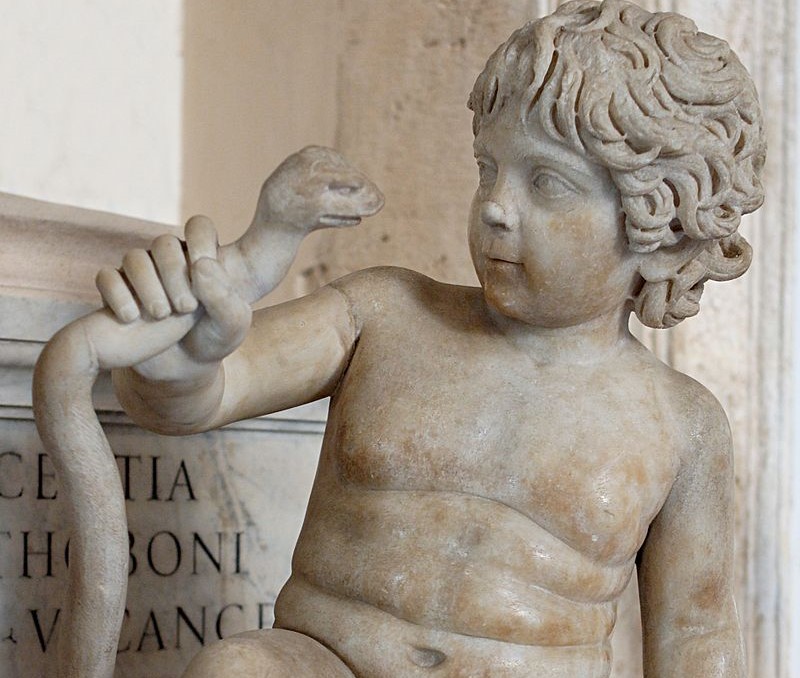
flesh of the babes. Herc sat bolt upright ready
for his first taste of combat; grabbed each serpent’s neck
with his strong infant hands and squeezed with all his might
until the beasts fell lifeless in his grip for want
of breath. The midwives caring for pale Alcmene
at her bedside froze with fear, as mum herself leapt
unclothed to her feet to fend the murderous onslaught
of the monsters off. En masse, the bronze-clad Cadmian
chiefs rushed to the rescue; flushed with adrenalin,
Amphitryon unsheathed his sword. Heartbreak’s a thing
alike for all who suffer sorrow of their own;
recovery swift for those whose hearts bleed only for
their fellow-men. Stepdad thus stood transfixed by wonder
and amazement mixed with the joy of sweet relief,
seeing the marvelous fortitude and sheer strength
of his son—ill-tidings brought by baleful messengers
belied by the luck richly bestowed upon him
by immortal gods. He calls out to his neighbor,
the illustrious prophet of almighty Zeus,
truthful Teiresias, who foretells for the king
and his attendant throng how many souls the boy
will slaughter on dry land, how many misbegotten
monsters he will lay to rest at sea; and tells
of one especially execrable character
who struts this earth full of contempt for other
mortal men, whom too good Heracles will go on
to consign to the doom the brute is due. He tells
how also upon the Plain of Phlegra in Thrace,
gods shall do battle with giants and, under a hail
of arrows from our hero’s bow, the latter shall
be felled; their lacquered locks strewn in the dirt, clotted
with brains and gore. While, he, our hero, shall enjoy
uninterrupted and perpetual peace and repose
in recompense for his great labors, hostelled
among the dwellings of the blessed; and shall eventually
take Hebe, handmaid of the gods, fresh in the bloom
of youth, to wife, and celebrate the marriage
with a lavish wedding feast, toasting the sacred
laws before the son of Chronos—god almighty
Zeus.
 Poetry, Politics and Language
[…] Nemean One — translation from the Ancient Greek of Pindar’s First Nemean Ode […]