[This first post in a new series attempts to trace the history and origins of certain buzzwords and examples of contemporary business jargon. Etymology is always a speculative science at best. Especially so for the kind of grassroots etymology explored here. Contributions from readers and fellow-bloggers are therefore, as always, extremely welcome.]

Photo by Etienne Boulanger on Unsplash
Boards Everywhere
The word ‘board’ (and the various terms derived from it) is so common that it can easily go unnoticed. Like chipboard and cardboard, you find it everywhere these days. There is a dashboard in front of you when you drive and a keyboard under your fingertips when you use a computer. Inside the computer there is a motherboard and various other boards. Cupboards line our walls. Billboards line the roads. The whiteboard has survived the transition to online classrooms. And, anyone lucky enough to be successful in a job application, is more likely than not these days to undergo a process of ‘onboarding,’ a corporate rite of initiation into high-tech tribes, which is defined by the Oxford English Dictionary as ‘the action or process of integrating a new employee into an organization’. This used to be called simply ‘induction’ or, more graphically, ‘showing someone the ropes.’
Onboarding
This particular item of business jargon is in fact so recent that it was first included in the Oxford English Dictionary in 2015 and in Merriam Webster in 2017.
It would seem logical to suppose that the term derives from the boarding of a cruise ship or some other passenger service. However, it may also be related (more directly) to phrases (such as ‘Are you onboard with that?”) which were already commonly used in the workplace to indicate compliance, agreement or support.
It is, therefore, not entirely clear in the case of ‘onboarding’ which association came first: that of boarding a ship or that of agreement, compliance or support.
Two kinds of board
The ‘board’ in English has two distinct roots—one relating to a wooden plank, the other meaning side (a cognate of the word ‘border’). Since both the decks and the sides of ships tended, until quite recently, to be made of wood, the verbal form of the word came to be used both for climbing up onto and pulling up alongside a ship. ‘Boarding’ is ambiguous in this sense.
‘Board’ meaning a wooden plank has also given us the phrase ‘board and lodging’, the board in this case being a table, used metonymically to refer to meals. Cupboard is such an ancient word (and a common one at that) that the pronunciation of ‘board’ has been simplified to /bəd/. Cardboard, although a more recent word is moving along the same trajectory due to high frequency of use.
Idioms
A number of idiomatic expressions however derive more from the meaning of ‘side’, especially of a ship.
The phrases ‘go by the board’ and ‘go overboard,’ for instance, stem originally from the terms used to describe crew and/or materiel being lost over the side of a ship. There is also the nautical term ‘starboard,’ used to refer to the side of a ship that is on the right when facing forwards. An outboard motor, likewise, is one that is situated outside of the sides of the vessel.
The adverbial phrase ‘on board,’ however, originally meant alongside a ship and the verb ‘board’ meant ‘to bring one ship alongside another’. This term emerged around 1500 (as so many seem to do) and it was only in the early 18th century that it would start to become confused with ‘aboard’ which came at an earlier date to mean on the ship. ‘All aboard’ retains this use (although the phrase itself was only relatively recently coined in 1829 by analogy with French). The original meaning gradually became lost, as the term was transferred to newer forms of transport – trains, planes, spacecraft and so forth.
Onboard
Somewhat surprisingly, however, the term ‘onboard’ used adverbially or adjectivally, with no whitespace after the prefix, dates only from 1966 and was first used to refer to equipment installed on spacecraft.
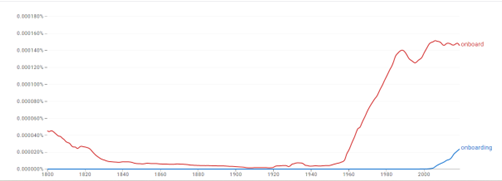
Figure 1 Google N-gram show frequency of terms ‘onboard’ and ‘onboarding’ clearly showing that ‘onboard’ dates back to the 1960s, while ‘onboarding’ first appears only in the present century.
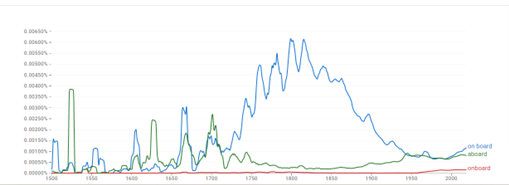
Figure 2 Google N-gram comparing Frequency of ‘on board,’ ‘aboard’, and ‘onboard’ 1500-present day. Note that ‘aboard’ and ‘on board’ are of very similar frequency until the early 1700s, and, again, the recency of ‘onboard’.
The question remains however as to when where and how this term came to be used in phrases such as ‘Are you onboard with that?” or “I can get onboard with that” to express agreement, compliance, or support for a certain set of objectives (usually in a business context).
Neither is it clear whether the currently fashionable use of ‘onboarding’ as a nominal form of a verbal extension of the adverb derives from ‘boarding a ship’ or ‘being on board’ in the sense of compliance. Undoubtedly both.
The fact that ‘board’ also meaning ‘table’ has meant that the term is also used in business parlance to refer to the group of executives who sit around the company’s main table. This connotation probably also comes into play here.
‘Above board’ may also be alluded to here. The sense being that you keep your hands over rather than under the table when playing cards to indicate that you are not cheating. That everything is ‘above board’.
The COCA corpus data
In an attempt to shed more light on the usage of this term, I consulted the Corpus of Contemporary American English (COCA) and examined the first 100 strings of text generated by a search for the keyword ‘onboard’ with no space after the prefix.
Results
In this sample, ‘onboard’ was used adjectively or adverbially in almost 100% of cases. On one single occasion it was used as a verb and on another as part of the phrasal verb ‘take onboard’. There was also a single occurrence of use of the word as a noun, to refer to some technical piece of equipment.
Containers and contents
All the other occurrences can easily be divided up according to the nature of what we may call the ‘content’ and the ‘container’ involved in the onboarding. For example, in the phrase ‘the sailors were onboard ship’ the content is the sailors, while the ship is the container.
The content can further be divided into two clear groups: human beings and/or activities requiring the presence of human beings; and objects of various kinds. There was one single occurrence of an event not requiring the presence of human beings (a fire).
The containers, meanwhile, fell into three clearly distinguishable categories: the main two being literal containers (always modes of transport) and figurative containers (organizations and ideas). The third category involves computers and their component parts.
Modes of Transport
In slightly over 51% of cases in this sample, the container is a form of transport and, in 40% of these, the mode of transport is a ship. This suggests that the term is still closely associated in usage with seafaring. It has, however, been extended to other forms of transport, almost all of which are represented even in this small sample (plane and spacecraft – 8% each; automobile – 7%; bus – 3%; train and bicycle – 2% each.) In two cases the mode of transport was unclear, and the context referred only to some kind of tour or trip.
In almost two thirds of the occurrences of the word involving transport, the term is used to refer to human beings (taken individually or as a group of individuals) or to activities that require the participation of human beings (selling duty free products or making a movie, for example). All but one of the other occurrences involved objects that are either equipment necessary for enabling or improving the functioning of the vehicle (e.g., onboard motor, a camera) or (more rarely) some extraneous object (e.g., ‘bombs’).
Figurative Usages
The second largest category (34% of the total) involves the container being used figuratively. In all such cases but one, the content is human (an individual or a group of individuals). In most instances, the figurative container is some kind of project or organization (a company, a record label, a publishing company, a job). In others it is more of an idea, although usually one that has practical applications (e.g., a policy or a strategy). Groups seen as a collective (rather than as a group of single individuals) (e.g., the government, congress) commonly appear as the content item in such instances. The only example where the content is not human involves the use of the phrase ‘take onboard,’ which may constitute an exception. In this case an idea is taken onboard by a group.
It is noteworthy that a large proportion of the pairings involving people and projects concern the making of a feature film, in particular a key player, such as an A-list celebrity, being ‘onboard’. This may, however, be due mostly to the type of online texts surveyed.
Two instances in this category differ somewhat from the norm. One of these concerns a TV critic describing him- or herself as being ‘onboard with a new series,’ meaning that they intend to follow it. This is an extension of the figurative use of the term for trends or ideas.
The other anomaly concerns a person being taken onboard by another person, presumably meaning that one person likes and is committed to the other. The context is again that of the entertainment industry.
Computers and their Components
A third category, accounting for 14% of the occurrences sampled here, involves computers. Computers are the only machine for which this word is used that is not a mode of transport. This may be because a computer resembles a mode of transport in some ways or simply because the term is associated with high-tech. It is not, for example, used with pre-modern forms of transport. A horse does not have a saddle onboard.
Overview
The word ‘onboard’ can be used as an adjective or an adverb to refer to the relation between a person, human activity or object and a mode of transport. For example:
[1] Passengers must refrain from smoking while they are onboard.
[2] Her birthday party was onboard a cruise ship.
[3] The plane will not take off until all luggage is onboard.’
By extension, the term can be used to refer to the relation between a person or group of people and a project or organization.
[4] The local council are onboard with the new housing project.
It can also be further extended to refer to the relation between a person/group and an idea.
[5] Lots of people are onboard with conservative ideas these days..
In addition to these uses, a significant minor category (16% of the total) concerns computer software being installed on hardware or (in some cases) one piece of computer software being installed within another.
[6] The phone’s onboard 5G capability makes it very popular with users.
The full data for this sample are presented in Table 1 below.
This brief analysis of a small sample of data suggests that there are clear semantic and pragmatic constraints on how this term is used. Interestingly, the sample contained only one example of the use of ‘onboard’ as a verb and this referred to being hired for a job and the term was considered sufficiently novel to require explanation in parentheses.
All of this suggests that ‘onboarding’ is a buzzword of very recent coinage drawing on an underlying pattern of using ‘onboard’ by extension from transportation to organizations, projects, proposals and ideas.
The Moral of the Tale
It is worth pausing awhile to consider the moral implications of the use of this word and those like it in a business context.
Compared to older terms such as ‘induction’ or ‘showing someone the ropes,’ the term carries a lot of ideological baggage, suggesting that the rookie employee should not only be aligned with the ideas of the organization but also eager to the enjoy the ride. It is surely somewhat deceitful and perhaps even downright manipulative to use such euphemisms foist such expectations upon people in the workplace. Induction would, on the face of it, be a more neutral and more honest term. It is also one that is empty enough to empower workers to fill it with new meanings in future.
Slavoj Zizek contrasts old-fashioned authoritarianism with the modern progressive version. In the bad old days, schoolchildren and workers were expected to attend their places of work and education, like it or not. They could grumble and secretly rebel as much as they liked so long as they turned up. The attitude was “I don’t care what you think. Just do it.” Modern office workers and school children are expected not only to ‘do it’ but to do so with genuine gusto. To be fully onboard. This surely is far worse. No wonder then that everyone is so stressed out in these supposedly more enlightened times.
Links
Here are some links to further information on this and similar themes:
https://www.merriam-webster.com/words-at-play/words-were-watching-onboarding
https://dictionary.cambridge.org/dictionary/english/onboarding
https://books.google.com/ngrams/
https://www.english-corpora.org/coca/
Coming Soon
Next up in this series: networking, stress, leadership, deliverables, competences, going forward.
Table 1 Occurrences of ‘onboard’ in COCA sample by category
| Person | Idea/Trend | Undertaking | TV series | Computer and similar | |||||
| Situation | Job | Project | Group | Company | |||||
| Object | 14 | ||||||||
| Person | 1 | 4 | 2 | 2 | 8 | 4 | 1 | ||
| Service | |||||||||
| Group | 2 | 9 | |||||||
| Activity | |||||||||
| Idea | 1 | ||||||||
| Event (non-human) | |||||||||
| Part of Self | 1 | ||||||||
| TOTALS | 1 | 6 | 2 | 2 | 18 | 1 | 4 | 1 | 14 |
| 35 | 14 | ||||||||
| Transport | Totals | ||||||||
| Trip | Spacecraft | Plane | Bike | Car | Ship | Train | Bus | ||
| Object | 6 | 1 | 1 | 6 | 2 | 1 | 31 | ||
| Person | 2 | 1 | 5 | 1 | 1 | 13 | 2 | 1 | 48 |
| Service | 2 | 2 | |||||||
| Group | 11 | ||||||||
| Activity | 1 | 1 | 3 | 1 | 6 | ||||
| Idea | 1 | ||||||||
| Event (non-human) | 1 | 1 | |||||||
| Part of Self | 1 | ||||||||
| TOTALS | 2 | 8 | 8 | 2 | 7 | 20 | 2 | 3 | 101 |
| 52 | 101 | ||||||||
*The total number of items is 101 because one occurrence involved both people and things being transported onboard a ship.
 Poetry, Politics and Language
Fascinating
[…] #1 On Board […]